

Cornelius Kistler didn’t set out to build a hundred-broker brokerage. Since founding breezeYachting.swiss in Zurich in 2013, he’s built something narrower and, by his own account, more interesting: a Swiss-run, content-led yacht brokerage that sells at a steady pace of roughly one vessel a month, treats every listing as a story to be told properly, and is now expanding into the US ahead of a television series launching this autumn. Here, he talks results over rhetoric, information parity, and why buying a yacht is more rational than people think.
Origins
A Decision Already Made For Him
You founded breezeYachting.swiss in Zurich in 2013. What was the moment or the frustration that made you decide to build your own brokerage rather than work within someone else’s?
Honestly, it was half frustration, half an opportunity I’m still really grateful for. My boss at the time moved from Switzerland to Germany, so they needed someone to run Sunseeker’s Swiss operation. It was the chance I needed, and of course I said yes.
But I also wanted to do things differently and, in my view, better: treat clients in a way that actually holds up over years, not just through the deal. And for me, that’s rooted in my Swiss values, being client-centric first, with no shortcuts.
And two years in, the German headquarters of Sunseeker went bankrupt. In hindsight, that was the moment the decision got made for me. I was already running my own show in every way that mattered, I just hadn’t put my name on the door yet.
Hindsight
The Lesson in Twenty Years
With over 20 years in the yachting industry, what do you know now that you wish you had known at the beginning?
To go all-in on technology, earlier. We were already ahead of the curve, among the first in yachting to do 3D tours, among the first to do video walkthroughs. Though, I have to admit, my first attempt at that was a GoPro clip from 2013 that’s still floating around somewhere online, and it’s quite rough.
I could have committed to that technological aspect harder and sooner, and stayed more focused on the brokerage itself. For a few years, up until COVID, I split my attention, because I thought I needed to do something that was perhaps more socially perceived as “serious,” like an IT company. I also ran a co-living startup in Hong Kong, similar to a coworking space. I actually sold the latter quite well, so I earned the badge of a successful exit, although a modest one. I’m still proud of that.
But yeah, that’s the thing I should have done earlier: focused fully on the brokerage, and gotten serious about technology sooner. We’re doing that now, at a real scale.
Philosophy
Swiss Values, By Design
The Swiss identity is central to how breezeYachting.swiss operates precision, discretion, honest advice. Was that a deliberate positioning from day one, or did it emerge naturally over time?
Absolutely, deliberate from day one. Swiss values are core to how we run the business and our culture, not just a marketing layer. It’s about delivering, plain and simple. We call it results over rhetoric. That really captures the way we work in three words.
You’ve spoken openly about brokers who avoid calling themselves brokers, preferring titles like advisor or consultant. Why does that bother you, and what does it say about where the industry is heading?
I’m proud to be a yacht broker. There was perhaps a brief stretch where I questioned that and considered calling myself a yacht advisor instead. But come on, that’s nonsense. We’re brokers. That’s the job. A title doesn’t change what you actually do, the work does. We’d rather be proud brokers who deliver than dress ourselves up as something else. That’s the standard we’re holding ourselves to.
The Boutique Model
Running Ahead of the Pace
breezeYachting.swiss sells approximately one yacht per month. What is the philosophy behind that pace and what do you sacrifice, if anything, by staying boutique rather than scaling?
We actually run a bit ahead of one a month, some periods 1.5, but 1.3 over the last four years, consistently. Where clients let us say so publicly, you can see the actual track record on breezeyachting.swiss/sold-yachts, every sale we’re able to share is listed there.
Could we hire more brokers and do more volume? Sure. We just opened a US operation, so we are growing. But I have no interest in building a hundred-broker brokerage, not at the moment, at least. Never say never, and if I find the right people to lead that kind of growth, I’m open to it. Right now, though, I see more value in the low-hanging fruit: better technology, better processes, a business built on a solid foundation. That’s what actually improves service quality, and it’s what gives our brokers more time for the part that counts, the human interaction.
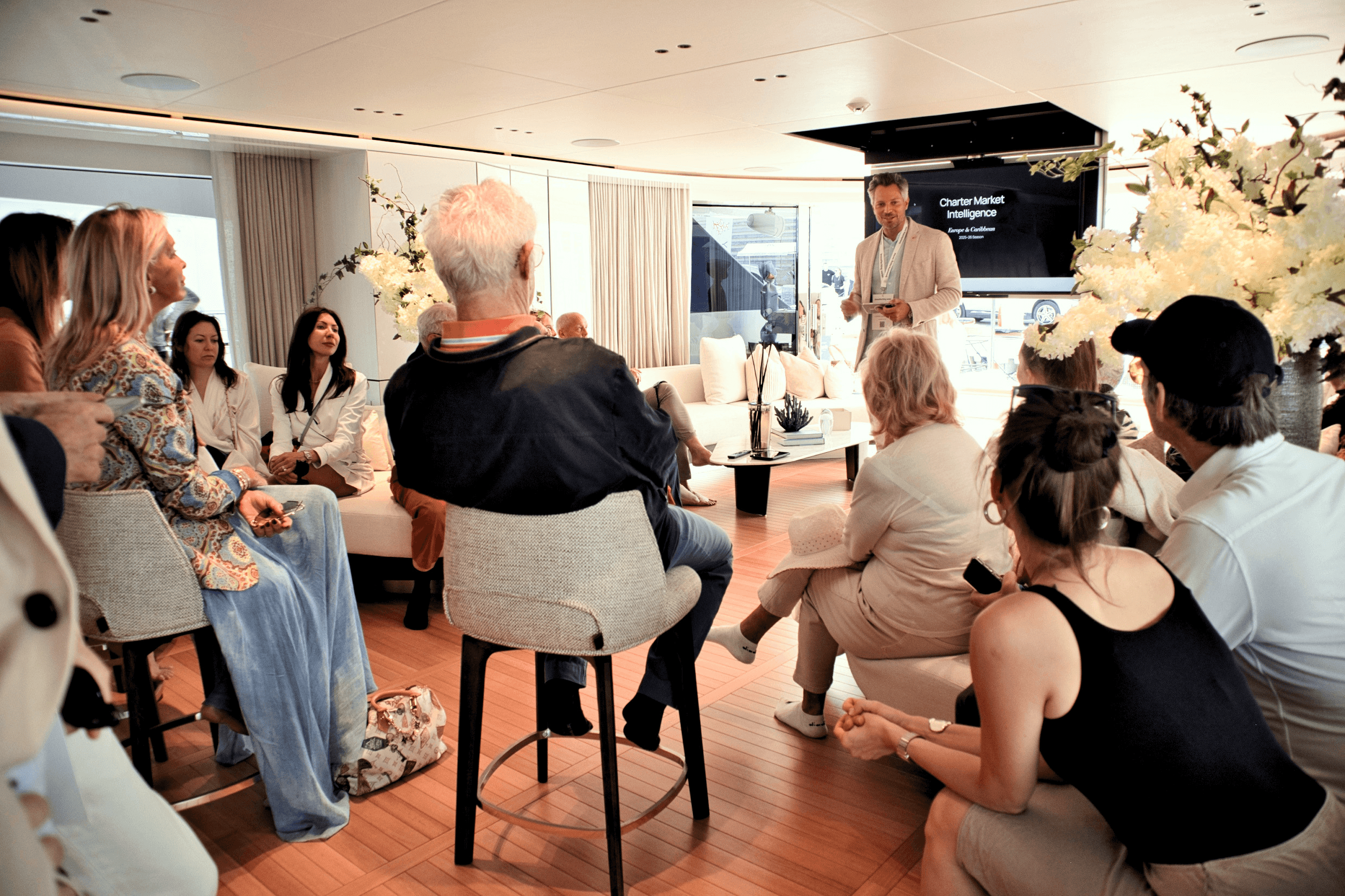
That’s the focus for the next twelve to eighteen months, alongside the TV show launching this August or September, a chance to put real storytelling behind the brand, harvest some of the attention that comes with it, and show that this job is actually fun. All of it serves the same mission: demystify yachting, make it accessible to people who want to understand it, own it, and actually enjoy it, which is amazing if you can afford it. Honestly, it comes pretty close to proving money can buy happiness.
As for what I sacrifice, honestly, nothing. Every stage has felt like the right next step. We keep building, keep improving a percent at a time, and that’s genuinely exciting to me. I don’t see it as a sacrifice at all.
The Craft
The Story Behind Every Vessel
You describe your approach as content-led telling the story of each vessel rather than simply listing it. Where did that instinct come from, and how does it change the conversation with a buyer?
Yachting is an emotional business, so you have to speak to the emotion. It’s also a fragmented market, every buyer wants something specific, and every boat, even a production model, ends up unique once you factor in its history and all the decisions made about its design. That means every boat needs its own story told properly.
The problem is that buyers are usually busy and far from where the boat actually is, so there can be a big gap between what they know and what’s actually true. Our job is to close that distance with information. We call it information parity: give the buyer as much detail as the seller has, so they can make a real decision and actually trust the listing.
Yachting is emotional as much as it is transactional your words. What does that look like in practice when you are sitting across from a buyer for the first time?
It means asking the big questions, not the easy ones. How do you actually want to spend your time, and with whom? How much of it do you think you have left?
That tends to get philosophical fast. But for me, that’s exactly why buying a yacht is actually quite rational. Sure, I get why people call it irrational, materialistic, I’m not going to judge anyone who thinks that. And I’m not saying it makes sense as a financial investment, it doesn’t, it burns money. But I’d invite people to think about what you actually get for that money.
And what you get can be genuinely valuable. It’s a platform, a facilitator, somewhere you actually spend time with your family. In a way, you’re buying back time, and if you look at it from a longevity perspective, it measurably relaxes you, resets your nervous system. That’s documented science, not something I invented. Call it a floating memory and longevity machine. Some of the most successful people I know spent decades without enough time for their families. Now they have the means, and the yacht becomes the thing that actually brings everyone back together, because really, who doesn’t want to spend time on a yacht?
Maybe that’s not the most profound motivation. But pragmatically, it just works. People want to spend time on a yacht together, they have a good time, they make good memories. They get to enjoy themselves and live by the sea for a while, visiting all their favorite places together. And that feeling is priceless. That’s why I keep saying this whole business is emotional, at every level.
Trust
The Quiet Approach
You have handled both public listings and discreet off-market deals. What kind of clients tend to want the quiet approach and what does discretion actually mean at that level?
Well, it’s simple: clients who don’t want to be public, who take their reputation and privacy seriously, want to operate under the radar, and it’s our job to make that possible.
That’s deeply rooted in Swiss values, understanding the mindset, the consequences, the attention to detail it takes. In practice, it means no one on our team is taking a selfie on the boat, in the shipyard, or near the client. It’s a constant awareness of what that level of care actually requires, and delivering it every time.
Is there a sale or a vessel that has stayed with you one that reminded you why this work matters beyond the transaction?
A few clients have become something close to friends over the years, and it’s genuinely rewarding to watch how their relationship with yachting evolves, where they go from one type of a vessel to another type of a vessel. For example, one Swiss client moved from a sailing catamaran to a displacement yacht, and being part of that shift in thinking, seeing how his priorities changed, that was really fascinating. Also being his sparring partner through that decision, and giving him advice he could actually rely on, is the kind of thing that reminds me why this job is worth doing.


On the Road
A Week That’s Never the Same Twice
breezeYachting.swiss operates across Lake Zurich, the Mediterranean, and major international yacht shows. What does a typical week actually look like for you?
Small correction first: we’re not on Lake Zurich anymore. We made the call to leave the Swiss lakes to the local partners and shipyards who already have the infrastructure and mooring in place, that’s their strength, not ours.
Beyond that, it really depends on the season. Find me in September and I’m flying between shows, Cannes one week, then Genoa, then Monaco. Last year I was filming for an international streaming series through that same stretch, September into October. So it’s a lot of variety, and a lot of travel. Other times I’m home, out for a walk in the forest, hiking in the mountains with my family. Or kitesurfing, that’s my therapy. And then other times I’m just sitting at my computer running deals, or producing videos and content. It’s a genuinely varied way to work, and I really enjoy it, even when it’s tiring. But you learn to know yourself, and how to recover. I’m genuinely grateful for all of it.
The Future
Where the Industry Is Heading
The yachting world is changing younger buyers, sustainability conversations, new technology on board. What excites you about where the industry is going, and what concerns you?
All of it excites me. We’ve supported sustainability initiatives for a few years now, including the Hynova hydrogen boat, where we contributed content, and the Hydros event, where students from different countries tested new concepts. I put real time into documenting that.
I’m fascinated by new technology, too. There’s this new product called the Foiler, I was on the early team, and the name was actually my idea. Still think that’s a bit funny. I wanted something as simple and category-defining as “Swiffer.” So yes, I’m not especially worried about where the industry is headed, because my mission is demystifying it, and more information and more transparency only help with that. Transparency gives people clarity. And clarity lets them make a decision, whichever way they choose, and that’s fine with me.
I’m not here to push anyone into a sale. I’m here to give good advice and see it through, whether that’s a buy, a sell, a transfer, or a build. That’s what sets us apart from a lot of other brokers: no unnecessary drama, just getting the job done, with the technology to back it up. Younger buyers notice that, and we hear it back from them more and more.
What’s Next
The Next Chapter
What does the next chapter of breezeYachting.swiss look like and what do you personally still want to achieve in this industry?
The next chapter is rolling out the technology we’ve been building behind the scenes, some of it won’t even be visible on the front end, but it’s a real step forward. The show’s release is part of that next chapter too.
Personally, I want to keep following the same mission: build the coolest yachting company in the business, one that stays focused on quality and keeps demystifying the industry. That means the culture too, collaboration, a good spirit, solving real problems for clients and partners, and having fun while doing it. Because at the end of the day, none of it works if you’re not enjoying it.
In Brief
Quickfire
A destination you’d sail to tomorrow if you could?
The Caribbean. Northern Sardinia. Greece. I just love Greece.
The yacht that changed how you see this world?
Cantiere delle Marche’s MAVERICK, the Flexplorer 146, is still one of my favourites. The Damen SeaXplorer 77 LA DATCHA is right there with it.
One thing most people misunderstand about buying a yacht?
First-time buyers underestimate how unique every single yacht is, and how unique the process is, too. Ownership structures differ, service histories differ, crews differ, and every seller has a different mindset. People assume buying one boat is the same as buying another. It never is. That’s exactly the thing we have to walk clients through.
The contract framework is built on a solid template, sure. But the documents, the negotiation style, the timing, all of it changes case by case. That’s exactly why you need someone with experience handling the transaction. Without a broker, you’d hit a wall on some detail and think, “this makes no sense,” fairly quickly. We approach every deal as a blank sheet of paper, because we know it can go in any direction, and there will be surprises.
Our job is making sure those surprises never reach the client, that it stays a smooth ride to closing. The amount of communication it takes, and honestly, how much it’s about understanding people’s psychology, that’s what most people underestimate.
– Cornelius Kistler, on what luxury means to him